by Lotus Ladegaard
Domanoff debuted onto the Ukranian Fashion Week back in 2008 and was awarded as the most commercially successful newcomer. Their collections are mostly styles with their own line of shoes, bags and jewelry. Each collection is done as a separate body of work and thus the style of the brand is ever-evolving. Domanoff often combines things that seem opposite in shapes, cuts, textures, style and makes use of a lot of handmade work showcasing their own unique techniques. Whatever the collection, Domanoff always delivers on quality and execution.
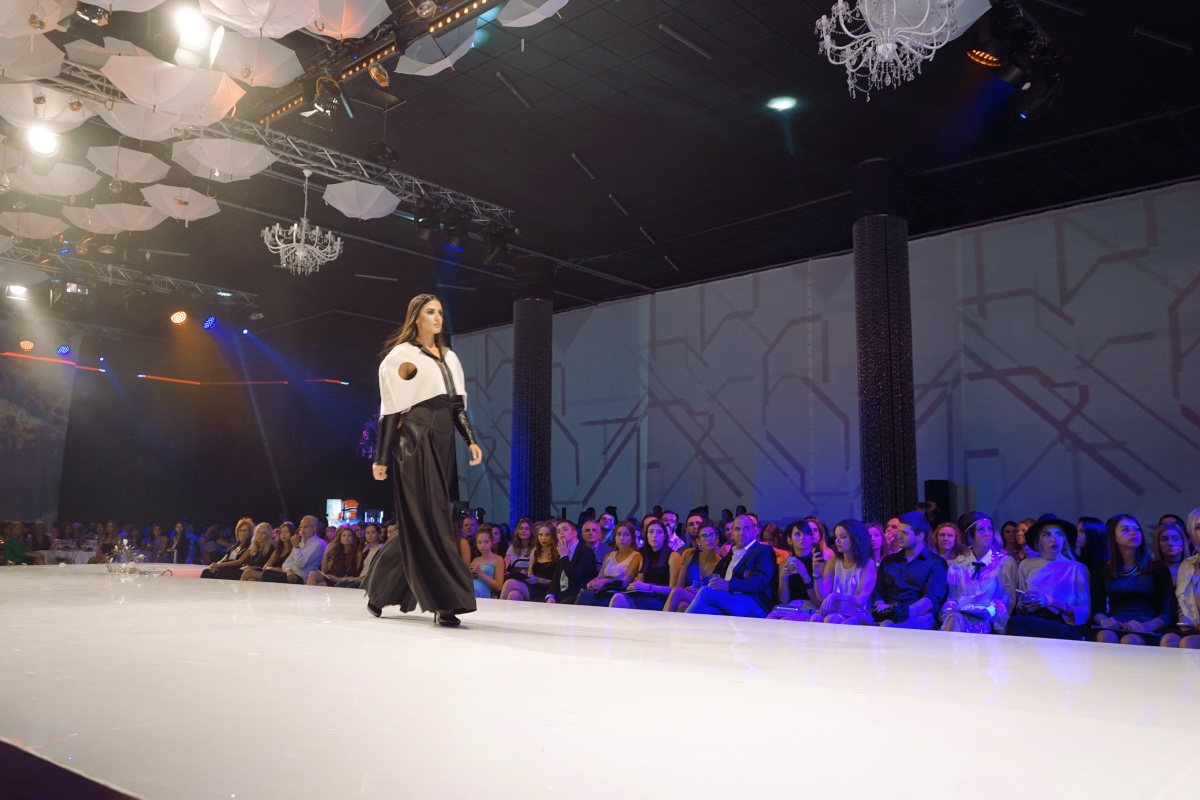
Domanoff's AW17 collection had something to offer all demographic. The colour palette was kept simple, blacks, greys and dark beiges with accents of red and gold. Domanoff's signature of mixing textures created a sophisticated yet modern and youthful collection.
From fitted dresses to flowy maxi shirt dresses and from edgy hemlines to conventional princess seams, Domanoff delivered on execution. The black red plat fabric was lined up beautiful at the seams, the draping was exquisite and in general, the tailoring was masterfully done. Gold accents were being used very thoughtfully without becoming distasteful or tacky at any point.
Domanoff's collection followed the trend of globalization with references to both Japan and Scotland, yet keeping it very European. I especially loved the kimono-inspired jacket and the tartan-inspired look. The coats and jackets were modern and sophisticated with an edge ranging from short fitted jackets to draped wrapped jackets and with long intricate designed coats.
Domanoff fused intricate design with a global narrative to provide us with a very consequential show.


Behind WEARETHEFACES are designers Amanda Karijord and Hannah Gutkauf, who have joined forces to produce unique and wearable clothing. WEARETHEFACES’ collections centers around a continuous dialogue with artists and are free of specific gender, style, season or trend conventions. It is a sustainable and conscious brand that believes in craftsmanship but also remains very curious when it comes to investigating new forms of fashion experiences, among other things, the design-duo has an ongoing online project to create wearable art. They are the faces. We are the gallery.
WEARETHEFACES' presented their AW17 mini collections in an organic venue to go with their sustainable perspective. The models were walking the short runway before their stood still and faced the audience.
The color palette was basic; blacks, blues and a dark khaki. The silhouettes referenced military wear with asymmetrical hemlines. The materials looked and felt rich despite the rough and raw edges on some of the pieces.
While I commend their efforts to make sustainable unique clothing, I am sad to see that it seems they had to compromise on amount looks and sometimes the execution. The collection had great potential but fell a little short. A few more looks would have tied the collection together more coherently and given a better showing. WEARETHEFACES delivered on craftsmanship although I would have loved to see some lining on the asymmetrical hemlines instead of just the unflattering backside of the textile.
WEARETHEFACES will be very interesting to follow in the future. Either way, the brand has shown great sustainable promise for the future.


Trine Lindegaard is a Danish Menswear designer focussing on sustainable manufacturing and social responsibility projects. She is influenced by traditional crafts from around the world. Among other initiatives, Trine Lindegaard’s collection includes crafts and manufacturing projects from UK prisons, collaborations with traditional Kente weavers in West Africa and design projects in Danish Asylum centers.
Trine Lindegaard graduated with a Master in Menswear from the Royal College of Art back in 2010, but she has also studied industrial pattern cutting and manufacturing at Carlo Secoli. Her graduation collection received international recognition and among other things, she was named one to watch by vogue.com
Trine Lindegaard's AW17 collection was a showcase of social responsibility. The collection and show have come alive with the cooperation of three social projects from a part of the Danish capital often referred to as the ghetto. Her aim was to put a positive spin on an area and its inhabitant that are often spoken of negatively. Through the project, the participants have a voice and an outlet where they can meet across culture, history, ethnicity and age.
The color palette ranged from black, grays, and whites to youthful pink and orange. Models came down the runway dressed athleisure and gave a take on the new trend. There seems to be a new trend at Copenhagen Fashion Week of garments with flowy embellishments whether it being sleeves, hemlines, trimmings, cuts or details and Trine Lindegaard too, followed up on that. The styling was androgynes and very unisex. The garments were in every way the product of her perspective and approach with words and childish drawings as embellishments to further spread her message of social responsibility and sustainable manufacturing methods. There seems to be a trend of garments with flowy embellishments whether it being sleeves, hemlines, trimmings, cuts or details and Trine Lindegaard too, followed up on that.
While there might not be a huge audience for her designs, her perspective, her ideals and her efforts to reach them will, however, appeal to most, I hope. Trine Lindegaard’s AW17 collection is different and exudes everything she stands for and that alone can win a big following.